
Toddler Feeding Guides
Toddler Food Texture Progression Chart: Purees to Family Foods (12–36 Months)
Complete toddler food texture progression chart from 12–36 months. Texture stages, signs of readiness, problem-solving texture refusal, and sample foods at each stage.
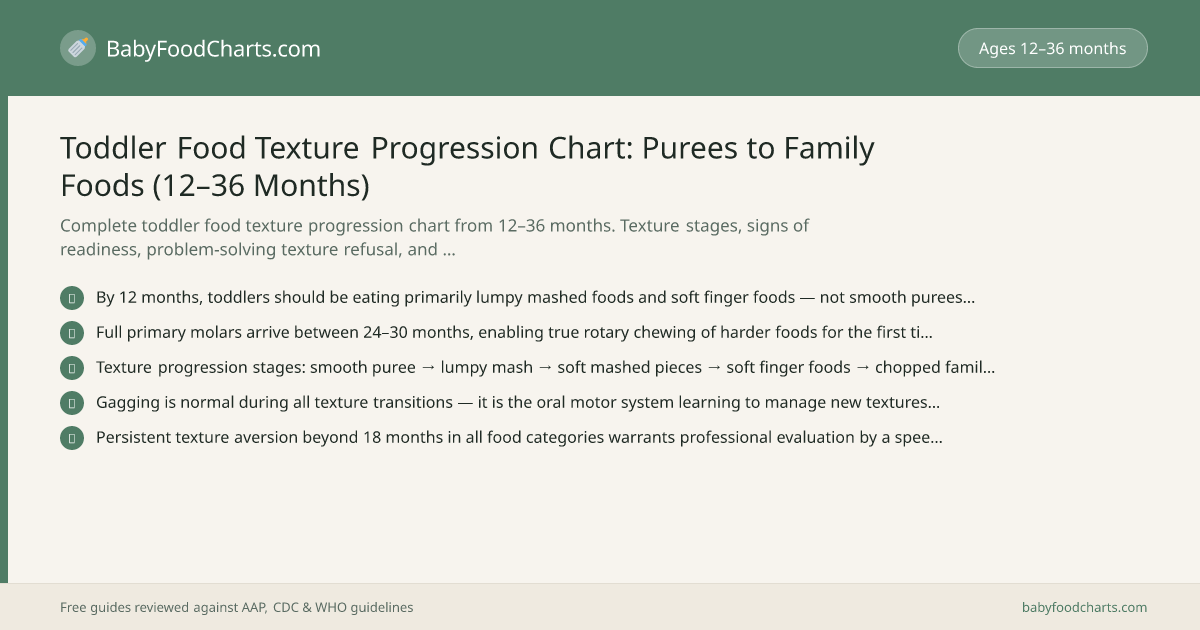

Every parent who has watched their toddler refuse a piece of soft-cooked carrot that would have been eaten without complaint as a puree has encountered texture: the invisible dimension of feeding that determines as much about what a toddler eats as flavour or hunger. Understanding how texture develops in the first three years — and how to progress through the stages without creating texture aversion — is one of the most practical feeding tools available to parents.
The oral motor development foundation
Texture progression is not about what foods you decide to offer. It is governed by what your toddler's developing oral motor system can manage. Understanding the developmental milestones helps explain why the texture targets exist.
Birth to 6 months: suckle and swallow only
Newborn oral motor function is limited to suckling and swallowing. The tongue moves in a simple forward-back pattern, and there is no ability to process solid food of any texture.
6–8 months: the beginning of munching
As solid foods begin, babies develop an up-and-down "munching" pattern on the gum pads — the precursor to chewing. This is enough to manage smooth and slightly lumpy purees, and soft food that dissolves with pressure (puffs, soft banana).
13–19 months: first molars arrive
The arrival of the first primary molars between 13–19 months enables lateral jaw movement — the beginning of real chewing. Food can now be moved sideways between the molar gum pads and processed. This is the point at which soft, well-cooked family food becomes manageable.
24–30 months: second molars arrive
The second primary molars complete the molar set and enable more efficient rotary chewing. By 30 months, toddlers can chew most foods that adults eat, with the remaining exceptions being specifically hard or tough textures.
What this means for texture progression
Each stage of texture progression is calibrated to what the oral motor system can do at that age. Offering textures ahead of the developmental stage does not accelerate development — it creates gagging, choking risk, and potentially texture aversion. But staying behind the developmental stage (remaining in smooth purees after 12 months) also creates problems: the brain's sensitive period for texture acceptance has passed, and acceptance becomes harder, not easier.
The 6 texture stages: 12 months to 36 months
Stage 4: Soft finger foods (12–15 months)
By 12 months, the goal is primarily soft finger foods rather than purees. The oral motor system can manage foods that:
- Break apart easily under gentle jaw pressure
- Do not require rotary chewing (which the first molars are still developing)
- Are soft enough to squish between thumb and forefinger
Size guideline: Finger-length strips (4–5 cm) at 12 months; smaller pea-size pieces as the pincer grasp develops
Appropriate Stage 4 foods:
- Steamed broccoli florets (the floret breaks apart easily)
- Soft-cooked carrot coins
- Ripe banana pieces
- Scrambled egg pieces
- Soft pasta shapes
- Shredded chicken (not chunks)
- Mashed potato formed into small balls
- Flaked salmon or sardine
- Soft-cooked rice grains
- Ripe avocado pieces
- Soft cheese pieces (mozzarella, ricotta)
Stage 5: Soft chopped pieces (15–18 months)
At 15–18 months, the first molars are either present or emerging. The jaw can begin lateral movement. Toddlers at this stage can manage slightly firmer pieces that require a little more chewing than Stage 4.
Appropriate Stage 5 foods (additions to Stage 4):
- Soft-cooked pasta that is not a long, stringy shape (penne, rigatoni, fusilli)
- Diced soft fruit: banana coins (larger), diced mango, kiwi pieces
- Soft-cooked meat that is diced small (not just shredded)
- Thick slices of very ripe soft fruit (peach, nectarine, pear)
- Soft bread torn into pieces
- Soft cheese in small cubes
- Well-cooked egg in pieces (no longer needs to be scrambled — a soft-boiled egg or slice of omelette)
- Soft-cooked lentils or chickpeas whole (they squish easily)
| Age | Texture stage | Key ability | Example foods | Preparation |
|---|---|---|---|---|
| 12–15 months | Soft finger foods | Palmar grasp; munching on gum pads | Broccoli, banana, scrambled egg, shredded chicken | Squishable under thumb + finger |
| 15–18 months | Soft chopped pieces | First molars emerging; early lateral chew | Diced soft fruit, pasta shapes, soft cheese cubes | Dice small; still very soft |
| 18–24 months | Modified family food | First molars in; true lateral chewing begins | Most family foods chopped; soft raw vegetables | Chop to 1 cm; shred tough meats |
| 24–30 months | Family food with modifications | Second molars emerging | More textures; thinner raw vegetable slices | Minimal modification needed; still no whole nuts |
| 30–36 months | Near adult textures | Full molar set; efficient rotary chewing | Most family foods | Only modifications: whole nuts, very hard raw, round foods |
Stage 6: Modified family food (18–24 months)
At 18 months, most toddlers have their first molars. They can now chew family food provided it is modified appropriately:
- Meat: chopped to 1 cm pieces rather than shredded
- Vegetables: cooked soft or, for naturally soft vegetables, offered raw in small pieces
- Round foods: still quartered (this continues until age 4)
- Grain: whole rather than pureed (normal family rice, pasta, bread)
At this stage, the goal is eating the same meal as the family with minor preparation differences, rather than a separate toddler meal.
New foods accessible at Stage 6:
- Thinly grated raw carrot
- Soft cucumber sticks (deseeded, skin off if firm)
- Very ripe fresh tomato pieces (quartered cherry tomatoes)
- Soft salad leaves
- Cooked fish in flakes (not baby-pureed)
- Avocado in larger pieces
- Most cooked meat in small pieces
Stage 7: Family food with minimal modifications (24–30 months)
As the second molars emerge between 24–30 months, rotary chewing becomes efficient enough for tougher textures. By this stage:
- Most family meals are appropriate without modification
- Tougher meats (steak, lamb chops) can be eaten if chewed adequately — monitor
- Some raw vegetables become manageable in appropriate preparation
- The palate has been exposed to enough variety that most foods are familiar enough to try
Foods to still modify:
- Round foods: still quarter grapes, cherry tomatoes, olives (continue until age 4)
- Whole nuts: still avoid until age 4 (nut butters thinly spread are fine)
- Very hard raw vegetables: still grate or slice very thin
Stage 8: Full family food (30–36 months)
By the third birthday, the full primary molar set is typically in place. A 3-year-old can eat almost everything a family eats:
- All soft and medium-firm textures
- Most cooked meats including tougher cuts
- All cooked vegetables
- Most raw vegetables prepared appropriately
- Bread, crackers, and grains of all types
- Most fruits (see safety notes on round foods)
Continued precautions through age 4:
- Round foods (grapes, cherry tomatoes): continue quartering
- Whole nuts, popcorn, hard candies: continue avoiding
- Very tough chewy meat: continue cutting to appropriate size
Managing texture refusal
Why toddlers reject new textures
Texture refusal is a normal part of toddler feeding for two connected reasons:
-
Developmental sensory sensitivity: The toddler nervous system is still calibrating sensory input from the mouth. New textures are genuinely surprising and sometimes unpleasant to a system that has not yet habituated to them.
-
Food neophobia: The same developmental mechanism that drives toddlers to be cautious about new foods applies to new textures. A previously accepted food presented in a new texture can feel like a new food to a toddler.
Effective approaches to texture refusal
Offer textures consistently without pressure: A toddler who is never offered lumpy food cannot habituate to it. Put the challenging texture on the plate, every time, without comment or expectation.
Use texture bridging: Introduce the new texture within a completely accepted context. If your toddler accepts smooth sweet potato puree, introduce lumpy sweet potato mash — same flavour, same context, but different texture. Once lumpy sweet potato mash is accepted, the texture of lumpiness itself becomes less alarming in other foods.
Give full control: Toddlers who feel controlled around food resist more. Offering preloaded spoons and finger foods where the toddler decides when and how much to put in their mouth gives them oral motor control. A toddler who can control the pace of texture introduction is more likely to explore.
Avoid rescue behaviours: Immediately removing a challenged texture, providing a smooth alternative whenever a lumpy food is refused, or negotiating the texture of food teaches the toddler that refusal is an effective strategy. The message should be consistent: the food is available; you decide if and how much you eat.
When to seek professional help
Signs that warrant a feeding evaluation
Texture refusal that is normal and expected:
- Refusal of 2–3 new textures while accepting others
- Preference for smoother versions of some foods
- Gagging occasionally on new textures followed by recovery
Texture refusal that warrants professional evaluation:
- Complete refusal of all textured food at 18+ months (only accepts smooth purees)
- Gagging or vomiting at every meal regardless of texture
- Refusing foods based on texture alone across all food groups
- Distress at the sight or smell of textured food (not just taste/texture)
- Extreme gagging on food that would not typically cause gagging in peers
Who provides texture and feeding evaluations
- Speech-Language Pathologist (SLP): Specialise in oral motor function, swallowing, and feeding. An SLP can assess whether the difficulty is oral motor (the ability to chew and swallow texture) versus behavioural (the willingness to accept texture).
- Occupational Therapist (OT): Specialise in sensory processing. If your toddler has sensory sensitivities beyond food (texture of clothing, sensitivity to sound or light), an OT can assess whether sensory processing differences are contributing to texture aversion.
- Pediatric Dietitian: Can assess whether the limited texture repertoire is creating nutritional gaps and guide a nutritional strategy while feeding therapy progresses.
Most feeding clinics provide multidisciplinary evaluations — a team of SLP, OT, and dietitian working together — which is the most comprehensive approach for significant texture difficulties.
Texture progression is one of the quieter success stories of the toddler years: most children move through these stages without drama, gradually expanding from the foods of early infancy to the family table. When difficulties arise, they are almost always addressable — the earlier they are identified and supported, the more quickly the trajectory adjusts.
Frequently asked questions
What texture should a 12-month-old be eating?
By 12 months, the texture goal is soft, mashed lumps and soft finger foods — not smooth purees. A 12-month-old should be managing soft-cooked vegetables as finger foods, fork-mashed proteins, and foods that require minimal chewing. If still on smooth purees at 12 months, begin introducing texture immediately.
When can toddlers eat raw vegetables?
Safely raw vegetables begin around 18–24 months for very soft options (cucumber, avocado) and 24–36 months for firmer options when very thinly grated or sliced (carrots). Hard raw carrot sticks remain a choking hazard until age 4. Most vegetables should still be cooked soft at 24 months — raw options are an addition, not a replacement.
My toddler only eats mushy food at 18 months — what do I do?
Start by introducing tiny, barely perceptible lumps into accepted smooth foods (mash with a fork rather than blending, leave a few small soft pieces). Introduce finger foods of the same food the toddler accepts in smooth form. Consistently offer, without pressure. If texture aversion is severe and applies to all foods at 18+ months, seek a pediatric feeding evaluation.
When can toddlers eat raw fruit?
Soft raw fruits (ripe banana, soft pear, ripe melon, ripe mango) are appropriate from 6–12 months in safe sizes. Firmer raw fruits (apple, raw pear) require preparation modifications: very thin slices (no sticks) from 18–24 months, quartered at minimum for all round fruits until age 4. Always match the firmness of the fruit to your toddler's chewing capacity.
What is oral motor development and why does it affect texture?
Oral motor development refers to the coordination and strength of the muscles of the mouth, jaw, tongue, and cheeks involved in chewing and swallowing. Toddlers develop the rotary chewing motion (moving food side-to-side between molars) only when their first primary molars arrive at 12–18 months. Before molars, toddlers mash food on gum pads — which limits the textures they can safely manage.
When do toddlers get their molars?
First primary molars typically arrive between 13–19 months. Second primary molars (completing the full molar set) arrive between 25–33 months. Before the first molars, toddlers cannot perform true lateral chewing. Before the second molars, they cannot efficiently chew tough or hard foods. This is why texture targets are tied to age ranges, not just developmental milestones.
Sources & references
- Texture and Food Acceptance in Infants and Toddlers, Nutrients Journal — NIH
- Responsive Feeding, World Health Organization
- Feeding Difficulties in Young Children, American Academy of Child and Adolescent Psychiatry
- Oral Motor Development, American Speech-Language-Hearing Association
- Pediatric Feeding Disorders, Pediatric Feeding News
BabyFoodCharts Editorial Team
Reviewed against current pediatric feeding guidance
Our editorial team researches and reviews every guide for accuracy and clarity. This content is educational and is not a substitute for advice from your own pediatrician.
Browse these topics
Related articles
Continue reading
Read nextFoods to Avoid for Toddlers Ages 1–3: Complete Safety GuideRecently updated
Note: BabyFoodCharts provides general educational information. It is not medical advice. Consult your pediatrician before introducing new foods, especially common allergens.